AI Revolution Hits Animal Health: Wake Up or Wipe Out?


January 5, 2026
Imagine this: In the next 5 years, a nimble start-up uses AI to slash drug development time in half, launching breakhrough vaccines at a fraction of today's costs—while legacy players scramble to catch up. Sound farfetched? It's not. AI-powered precision medicine is barreling toward animal health like a freight train, and those sleeping on it risk total disruption.
I’ve been using AI for a long time—most probably I started way sooner than many people, even before most companies jumped on the wagon. That early experience gave me solid insight into what AI is truly capable of and its real impact on precision and AI-driven medicine in both human and animal health industries. Thankfully, I never got caught up in the hype. For me, AI has always been a powerful tool that unlocks massive computational power, makes internet searches far more planned and precise, and excels at crunching databases and analysing complex data.
During my journey with AI models, I’ve come across some shocking issues—not just logical flaws, but outright wrong outcomes and inaccurate information. It was genuinely eye-opening how often things went off track. Yet, since those early days, I’ve also witnessed massive improvements, especially when AI is harnessed within everyday tools like Office programs or industrial design software. Of course, I’ve never had the chance to use advanced platforms like AlphaFold (the full version is paid, and honestly, I wouldn’t even know where to start—it must be incredibly complex). But what I do know is that these tools are extremely powerful.
Anyway, what I’m trying to say is this: if anyone still has serious doubts about how AI is reshaping the pharmaceutical and biotechnology industries, don’t pay too much attention to them—with all due respect. That sceptiism usually comes from old-fashioned, outdated leadership. Integrate powerful AI tools immediately, but more importantly, empower your teams with the freedom and opportunities to master them. You’ll come out as the winner. Training is absolutely key: teach everyone to challenge every output from AI to avoid terrible mistakes.
(By the way—this article was also written with the help of AI, at least for gathering and structuring the data part. But I swear, this is 100% my voice, writings and views.)
My view on AI fueling this revolution? It's raw computational muscle hooked to endless online knowledge, supercharged by math like neural networks. But here's the speculation: AI still can't truly "think" independently—no self-built databases from pure creativity or freedom. Yet, as it edges toward autonomous evolution (think next-gen models self-refining hypothesses), it could shatter barriers, birthing innovations we can't even predict...
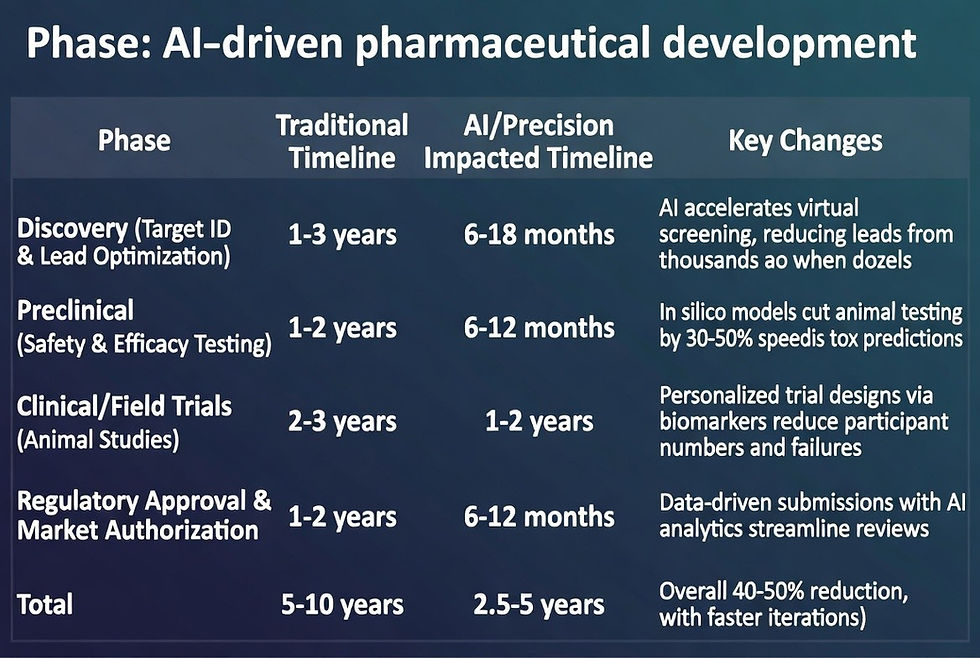
The real game-changer? AI-driven development of new medicines and vaccines—poised to obliterate the old pipeline. Traditional R&D takes 5-10 years at $20-100M per medicine, dealt with endless trials. But speculate with me: AI's virtual simulations and predictive magic could crush preclinical phases by 50%, shave years off totals, and slash costs 20-50%. Result? Explosive innovation—hyper-targeted therapies for specific breeds or herds, ultra-fast responses to emerging diseases (remember we witnessed this at the Covid times desperatly
Here's the speculative showdown in timelines
And costs? Brace for this:

Leading companies like Zoetis, Merck Animal Health, Elanco, Boehringer Ingelheim are already pivoting hard—AI in their pipelines screams they're ready. I'm also confident that players like Ceva, Virbac, and Dechra are making moves in this direction (or at least that's what I want to believe—they certainly should be exploring AI integrations to stay competitive in the coming wave).
But mid-tier players? Many are asleep at the wheel, clueless or too slow to invest in AI/precision tech, clinging to archaic methods. Speculation: They'll get crushed, swallowed up, or vanish as agile newcomers exploit the gap.
And here's the warning—even the giants aren't safe. Hungry startups and biotechs, no legacy baggage, could master AI precision first, flooding markets with dirt-cheap, lightning-fast innovations in hot niches like pet oncology or livestock genomics. Market shares built over decades? Gone overnight.
Diagnostics will shift too—hyper-personalized via genomics and biomarkers—but practicality? Still doubtful with regulatory walls and scaling nightmares in real-world vets and practical use without massive infrastructural investments.
Who wakes up first wins big. Who's sleeping? Game over.
What’s your bold prediction for animal health in the AI era? Drop it below!
References (key sources):
HealthforAnimals/AHI: Baseline costs ~$22-62M, 6-8+ years.
Emerging reports: AI projections for 40-50% timeline/cost cuts via in silico advances.
Leaders: Zoetis et al. public AI initiatives.


Comments